
When Your Domain Controller Attacks Someone Else
CLDAP reflection turns Active Directory domain controllers exposed on UDP 389 into DDoS amplifiers. One 39-byte query in, kilobytes out, aimed at a victim the DC owner has never heard of.
Most attack-surface discussions ask what an attacker can do to you. Reflection attacks ask a different question: what can an attacker do with you? A domain controller that answers queries from the Internet does not need to be breached to be useful. It only needs to reply.
Cloudflare's DDoS Threat Report for Q3 2026 shows how quickly this technique can rise and fall. CLDAP reflection attacks surged 580% in the first half of 2026, then collapsed to just 0.05% of network-layer attacks in the third quarter as attackers moved to DNS amplification. That collapse is easy to read as good news. It is better read as a reminder that the reflectors are still out there, waiting for the next booter service to pick them back up.
Why Domain Controllers Speak CLDAP
Connectionless LDAP (CLDAP) is LDAP carried over UDP instead of TCP. Active Directory uses it for a routine job: when a Windows client needs to find a nearby domain controller, the DC locator process sends a small UDP query to port 389 and the DC answers with information about itself. No session, no handshake, no authentication.
That design is fine inside a corporate network. The problem starts when UDP 389 is reachable from the Internet. This happens through overly broad firewall rules, DCs placed directly on public addresses, cloud-hosted DCs with permissive security groups, or a lab server that was never meant to be public. At that point the DC will answer anyone, including a forged request.
The Vector: 39 Bytes In, Kilobytes Out
The query attackers use is a search of the rootDSE, the anonymous entry at the top of the directory that describes the server. Encoded, it is just 39 bytes of UDP payload:
30 25 02 01 01 63 20 04 00 0a 01 00 0a 01 00 02
01 00 02 01 00 01 01 00 87 0b 6f 62 6a 65 63 74
63 6c 61 73 73 30 00

searchRequest: base "" · scope base · filter (objectClass=*) · all attributes
The DC answers with every rootDSE attribute it has: naming contexts, supported controls and capabilities, server names, functional levels, and more. That response commonly runs to several kilobytes. CISA's guidance on UDP-based amplification lists CLDAP with an amplification factor of roughly 56 to 70 times. A booter that can send 1 Gbps of queries can, in principle, direct tens of gigabits at a target, all of it coming from servers that belong to someone else.
The Attack Path
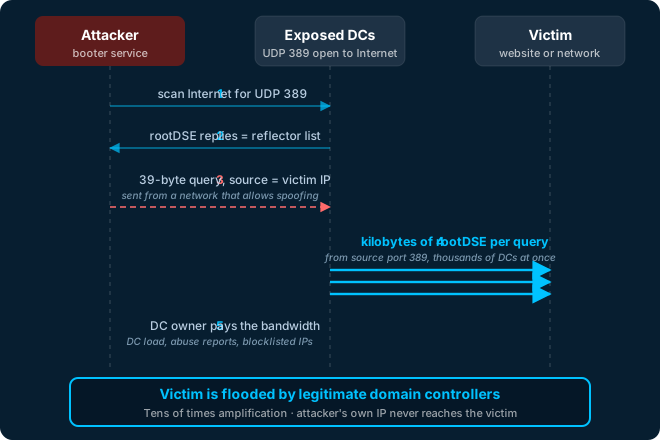
- Recon. The attacker scans the IPv4 space for hosts that answer a rootDSE query on UDP 389. Every responder goes on a reflector list. These lists are traded and reused, so a DC that was exposed once may stay on them long after.
- Spoof. From a network that does not filter forged source addresses, the attacker sends the 39-byte query to thousands of reflectors, with the victim's IP address as the source.
- Reflect. Each DC does exactly what it was built to do and sends its full rootDSE response to the address in the packet, which is the victim.
- Flood. The victim receives a wave of large UDP packets, many of them fragmented, all arriving from source port 389 on legitimate servers. The attacker's own address never appears.
The DC owner is a casualty too. Their outbound bandwidth carries the attack, the DC spends cycles answering junk, and their public addresses collect abuse complaints and may land on blocklists. An exposed UDP 389 also tells every scanner that a directory server is sitting on the Internet, which is useful reconnaissance for a far more serious intrusion.
Why the Collapse Is Not a Safety Signal
Cloudflare's data shows attackers abandoning CLDAP almost overnight. In the same quarter, DNS amplification grew 215% and generic UDP floods rose from 14.06% to 31.31% of network-layer attacks. Booter operators pick whatever vector is cheapest and least filtered this month. When upstream providers and scrubbing services tune for one protocol, the services rotate to another.
Nothing in that rotation removes an exposed DC from the Internet. The reflector lists still exist, the DCs still answer, and switching back costs the attacker nothing. A vector that dropped to near zero in one quarter can come back in the next.
Defensive Takeaways
Keep directory services off the Internet
No domain controller needs to answer UDP 389 from a public address. Audit perimeter rules, cloud security groups, and any DC with a public IP, and close the port at every layer.
Scan yourself from the outside
Internal views miss what the Internet can reach. Schedule external scans of your address space for CLDAP, open DNS resolvers, and other UDP reflectors, and treat any hit as an incident to close.
Watch outbound traffic from port 389
Large volumes of outbound UDP from source port 389 to external addresses means your DC is reflecting. Alert on it in firewall or flow logs, and drop spoofed egress traffic (BCP 38) so your own network cannot launch the queries either.
Final Thoughts
CLDAP reflection needs no exploit and no stolen credentials. It needs a domain controller doing its job in the wrong place. Cloudflare's Q3 numbers show attackers moving away from the vector for now, but the cost of returning to it is zero. Closing UDP 389 to the Internet is one of the cheapest fixes in security, and it protects people you will never meet.
Sources
- Cloudflare Cloudforce One, "Cloudflare DDoS Threat Report 2026 Q3: More swarms, fewer giants" (Oct 29, 2026)
- CISA, Alert TA14-017A, "UDP-Based Amplification Attacks" (updated guidance including CLDAP)
- Microsoft, [MS-ADTS] Active Directory Technical Specification, LDAP ping and DC locator behavior
- IETF RFC 1798, "Connection-less Lightweight X.500 Directory Access Protocol"