
The Rise of Voice Phishing: When the Phone Call Becomes the Attack
How vishing is exploiting the one attack surface that security tools cannot easily reach
Phishing is no longer just an email problem.
While organizations have invested heavily in secure email gateways, URL scanning, and user awareness programs, attackers have been quietly shifting their approach. Voice phishing — commonly referred to as vishing — is accounting for a growing share of real-world social engineering attacks. The reason is straightforward: the phone call bypasses most of the controls that have made email phishing harder to execute successfully.
Why Attackers Are Moving to Voice
Email-based phishing has become progressively more difficult to execute at scale. Secure email gateways filter suspicious domains, URL scanners detonate links before users click them, and years of awareness training have made employees more skeptical of unexpected messages.
Voice attacks sidestep this infrastructure entirely. A phone call does not pass through a gateway, does not contain a URL to scan, and does not give the recipient time to consult a policy document or verify the sender's identity through a secondary channel. It lands in real time, creates immediate pressure, and exploits something that technical controls are not designed to address: human decision-making under stress.
How Vishing Attacks Work
A typical vishing scenario follows a predictable structure, even if the details vary by target.
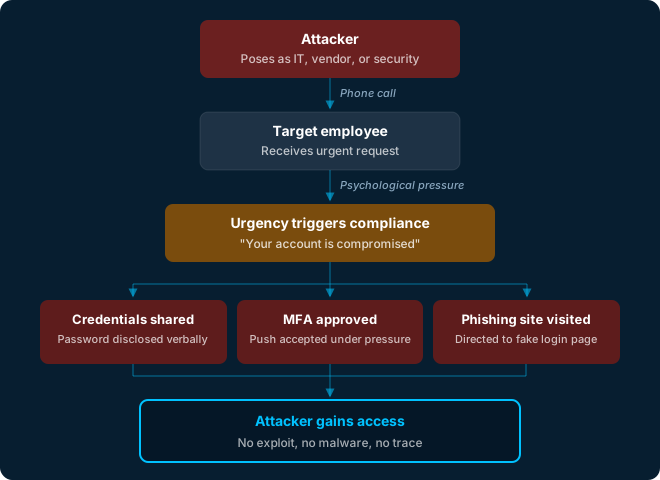
The attacker calls posing as a trusted figure — IT support, a vendor, a member of the security team, or occasionally someone from HR or finance. The impersonation does not need to be technically sophisticated. It needs to be plausible enough to create a moment of compliance before the target has time to verify.
Urgency is the primary tool. Phrases like "your account has been compromised" or "we need to reset your credentials immediately" are designed to compress the decision-making window. Under time pressure, people tend to act quickly, defer to perceived authority, and reach for familiar behaviors — all of which work in the attacker's favor.
From there, the victim is guided toward one of several outcomes: sharing credentials directly, approving an MFA push notification, or visiting a phishing page to "verify their identity." The attack succeeds not because of a technical vulnerability, but because psychological pressure produces compliance faster than verification can occur.
Why Voice Is More Dangerous Than Email
Email phishing leaves artifacts. There is a message to analyze, a URL to inspect, a sender domain to evaluate, and a timeline that can be reconstructed. Security teams can pull the email, run it through analysis tools, and build detections based on what they find.
Voice attacks leave very little behind. Unless calls are recorded and reviewed — which most organizations do not do systematically — there is no payload to analyze, no link to detonate, and no obvious indicator of compromise to feed into a detection rule. The attack happens in real time, in a channel that most security tooling does not monitor, exploiting a cognitive process that cannot be patched.
This combination — high effectiveness, low artifact footprint, and minimal technical barrier — makes vishing an increasingly attractive option for attackers who find email defenses maturing faster than their campaigns can adapt.
Defensive Takeaways
Establish clear out-of-band verification procedures
Employees should have a documented, practiced process for verifying unexpected requests — regardless of how urgent or authoritative the caller sounds. A callback to an official number, not one provided by the caller, is the baseline control.
Train for voice-specific scenarios
Most awareness programs focus on email. Effective vishing defense requires training that includes simulated phone-based attacks, realistic role-playing exercises, and explicit discussion of the psychological tactics attackers use. Recognizing urgency as a manipulation technique is a learnable skill.
Strengthen MFA against fatigue attacks
Number matching and phishing-resistant MFA significantly reduce the effectiveness of push-based vishing attacks. Organizations still relying on simple approve/deny notifications should treat repeated push requests — especially unsolicited ones — as an indicator worth investigating.
Build a culture that rewards verification over speed
One of the most effective defenses against vishing is organizational culture. Employees who feel empowered to pause, question urgency, and verify requests through official channels — without fear of appearing uncooperative — are materially harder to manipulate than those operating in an environment that penalizes friction.
Final Thoughts
The next phishing attack targeting your organization may not arrive in an inbox. It may come through a phone call that sounds entirely reasonable, from someone who knows enough about your environment to be convincing, at a moment when the target has no obvious reason to be suspicious.
Technical controls remain important, but they were not built for this channel. The strongest defense against voice-based social engineering is a workforce that understands how these attacks work, knows what verification looks like in practice, and has the confidence to slow down before acting on an unexpected request.
The attacker is counting on urgency. The defense is a pause.